

Four possible payers, and how to work out which is yours
Almost nobody knows the answer to this question when they need it, and the uncertainty routinely delays decisions by days that the property cannot afford.
There are four realistic sources of payment for Unattended Death Cleanup in Ohio. Most situations map cleanly to one of them once you know the three facts that decide it: who owned the property, who the deceased was in relation to it, and whether a crime was involved.
| Scenario | Usual payer |
|---|---|
| Deceased owned and occupied the home | Homeowner’s insurance, then the estate |
| Deceased was a tenant | Landlord’s dwelling policy, or the tenant’s estate |
| Deceased was a family member in your home | Your homeowner’s policy |
| Death resulted from violent crime, no policy | Ohio Crime Victims Compensation Program |
Scenario 1: Homeowner’s insurance
This is the most common answer and the one people least expect.
Most Ohio homeowner’s policies cover trauma and unattended death remediation under dwelling coverage, because it is work required to return the property to a safe and habitable condition rather than a cosmetic improvement. You pay your deductible and the policy responds to the remainder, subject to any coverage limits.
Three things make a claim go smoothly:
Notify early. Within a day or two, before work begins. You do not need to have chosen a company first.
Do not clean anything. The before condition is the foundation of the file. A room that has already been disturbed is very difficult to assess.
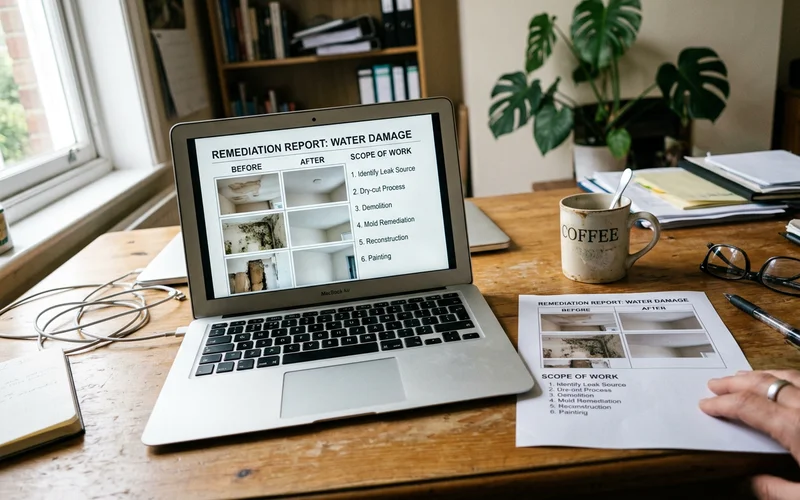
Document everything. Photographs, itemized scope, disposal manifests, verification results, after photographs. We produce all of this through the Client Portal as standard because adjusters approve scope they can see evidenced.
Watch for a vacancy clause if the property had been unoccupied for an extended period. Raise it with the adjuster early rather than having it surface mid-claim.
Our guide on whether insurance covers crime scene cleanup in Ohio covers the claim process in more depth, including exactly what to ask your adjuster.
Scenario 2: The estate
Where the deceased owned the property, remediation is generally an expense of the estate, paid from estate assets by the executor or administrator.
In practice this often runs alongside an insurance claim rather than instead of it. The policy responds, the estate covers the deductible and anything outside coverage, and the executor signs.
Practical points for executors:
- Authority matters. We need to know who is authorized to approve work before a crew enters, and letters of authority resolve that cleanly.
- Remediation is generally a legitimate and necessary estate expense. Document it as such.
- Where the property will be sold, a documented remediation record is an asset. Buyers ask, and being able to show the file rather than describe it changes the conversation.
Where the estate has no liquid assets, tell us. Remediation before probate concludes is a common problem and it is sometimes possible to structure the work around it.
Scenario 3: Tenant deaths and landlord policies
Where the deceased was a tenant, responsibility depends on the lease, the policy, and whether the estate has assets.
A landlord’s dwelling policy frequently responds to the remediation, subject to deductible and any vacancy provision. The tenant’s estate may be liable for damage to the unit, though recovering from an estate with no assets is often impractical.
The honest position most Northeast Ohio landlords end up in: the dwelling policy covers the substantive cost, the deductible is absorbed, and pursuing the estate is not worth the legal expense.
Our guide on unattended death cleanup for landlords covers the operational side, including containment in multi-unit buildings and the documentation owners need.
Scenario 4: Ohio Crime Victims Compensation
Where the death resulted from violent crime and there is no insurance, the Ohio Attorney General’s Crime Victims Compensation Program can reimburse eligible claimants for cleanup costs.
The program is generally a payer of last resort, meaning it considers what other sources have already paid. Deadlines apply from the date of the crime, so an early application matters. Itemized invoices and a police report reference are the core documentation.
Do not let the funding question delay the remediation
Contamination continues moving for as long as the property sits, and the scope grows with it. Working the funding question in parallel with the work is almost always cheaper than resolving it first.

What we do to help
We cannot tell you what your policy covers, because only your carrier can. What we can do is make sure every route stays open.
That means an itemized written estimate before work, a final invoice matching that scope, disposal manifests, verification testing results, and before and after photographs, all in one place and formatted for an adjuster, an executor, or a compensation application.
If none of the four routes apply to your situation, say so early. We would rather scope a phased project that addresses the biohazard first than watch somebody leave a property unremediated because the whole number was out of reach.